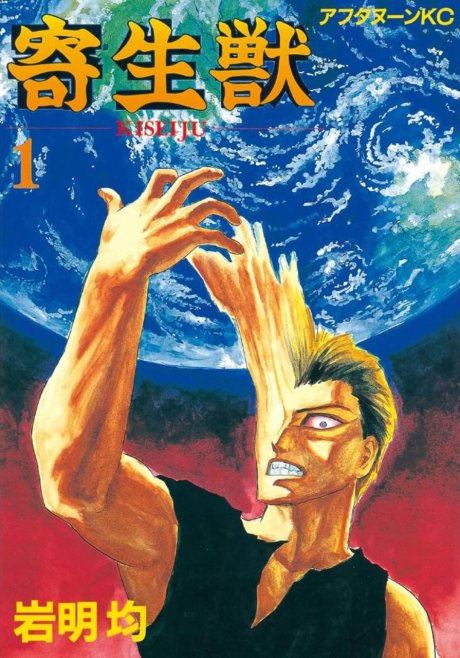
Parasyte
Parasyte — Quick Overview
|
Start Chapter 1
|
Latest Chapter
|
| Overview Story Characters FAQ | Chapters ↓ |
★ 8.2/10 · AniList Manga Action Male Protagonist Seinen Body Horror Aliens Completed
Parasyte (寄生獣, Kiseijū) is a classic psychological sci-fi horror seinen manga created by IWAAKI Hitoshi and published through Kodansha. When predatory spores fall to Earth, high school student Shinichi Izumi forms a reluctant biological symbiosis with Migi, an alien entity that takes over his right hand instead of his brain. Caught between lethal shapeshifting organisms and suspicious authorities, the pair must fight for survival while confronting the moral fragility of human nature.
| Author / Story : IWAAKI Hitoshi | Format & Status : Manga · Completed |
| Artist / Art : IWAAKI Hitoshi | Original Publisher : Del Rey, Kodansha |
Series Specifications (Year, Genres, Origin...)View all details ↓
| Release Year : 1988 | Demographic : Seinen |
| Country of Origin : Japan (Manga) | Reading Style : Right-to-Left (Manga) |
| Primary Genres : Action, Drama, Horror, Mature, Mystery, Psychological, Romance, School Life, Tragedy | |
| Core System / Theme : Parasitic Infiltration, Biological Symbiosis & Ecological Morality | |
Other Names & Verified AliasesView all
Kiseijū • Ký Sinh Thú • Parasitic Beasts • Parasyte • Parazit • Pasożyt • Паразит • الطفيلي • ปรสิต (SIC) • ปรสิตเดรฉาน (Pirate) • 寄生兽 • 寄生獣
Full Synopsis & Narrative BreakdownRead story
Silent extraterrestrial spores descend upon quiet Japanese neighborhoods under cover of darkness. Each microscopic organism burrows directly through an ear or nostril to hijack the host's brainstem, converting human heads into hyper-flexible, predatory weapons capable of bisecting bone and devouring unsuspecting prey. Seventeen-year-old high school student Shinichi Izumi narrowly averts this fate when he strangles his own arm with headphone cords, trapping an invading parasite inside his right hand. The organism matures into an independent entity naming itself Migi. Lacking access to Shinichi's brain, Migi must rely entirely on Shinichi's bloodstream to survive, forcing human and parasite into an uneasy biological truce.
While mysterious mincemeat murders proliferate across the city, Shinichi and Migi discover that assimilated parasites can detect each other through biological brainwave emissions. Fully transformed parasites view unassimilated hosts as potential liabilities or food, quickly marking Shinichi for elimination. As calculated predators infiltrate local politics and academic institutions under the calculating guidance of Ryoko Tamiya, Shinichi is thrust into deadly, close-quarters skirmishes. Following a devastating domestic ambush that infuses Migi's cells directly into his heart, Shinichi undergoes a radical physiological and psychological alteration, hardening his emotional reactions while sharpening his reaction speed to superhuman levels.
The narrative escalates from localized self-defense clashes toward systemic urban confrontation. Shinichi faces relentless biological constructs like the composite apex predator Gotou, while grappling with the erosion of his own empathy. Iwaaki strips away conventional superhero tropes to explore biological predation, environmental necessity, and what truly separates humanity from cold evolutionary instinct.
What to Expect
Parasyte features calculated, tactical kinetic skirmishes rather than extended power-scaling tournaments. Migi operates on cold geometric efficiency, morphing Shinichi's fingers into razor ribbons, hardened shields, and ranged kinetic projectiles, forcing battles to hinge on terrain leverage, stamina constraints, and split-second tactical deception. Pacing remains taut across all 64 serialized chapters, progressing steadily from isolated horror encounters into large-scale military extermination operations and the climactic wilderness showdown against Gotou. Throughout this escalation, the narrative focuses sharply on the moral and psychological drift between human sentiment and absolute survival logic.
Who Will Enjoy This
Readers searching for grounded psychological horror, high-stakes body horror, and tight narrative pacing will find Parasyte essential reading. The series serves as foundational source material for modern dark fantasy and biological invasion stories.
For readers who appreciate visceral physiological mutations, identity loss, and moral conflict, exploring Tokyo Ghoul is a natural next step, as both titles examine protagonists caught between human society and flesh-eating predators. Similarly, readers interested in military-scale responses to grotesque biological threats and weaponized bodily transformation will find compelling parallels in Kaiju No.8.
Key Early Characters (Shinichi, Migi, Satomi, Ryoko)View cast
|
Shinichi Izumi
A timid, kind-hearted high school student whose right arm becomes host to Migi. Initially terrified of conflict and blood, his personality grows analytical, stoic, and physically enhanced following cellular fusion with his parasitic partner, driving his motivation to shield innocent civilians and his family.
|
Migi
The alien parasite integrated into Shinichi's right arm. Possessing no human empathy, Migi operates solely through calculated self-preservation and rapid intellectual absorption, capable of morphing into dense blades, sensory appendages, and projectile tools while studying human behavior.
Satomi Murano
Shinichi's classmate and close romantic interest. Observant and emotionally intuitive, Satomi serves as Shinichi's primary moral anchor, repeatedly noticing his psychological distance, chilling coldness, and subtle physical alterations as he drifts away from standard human emotion.
Ryoko Tamiya (Reiko Tamura)
A high-ranking parasite who successfully usurps the body of a high school teacher. Possessing exceptional philosophical curiosity, she avoids mindless consumption in order to conduct scientific inquiries into parasite reproduction, human coexistence, and evolutionary purpose.
Frequently Asked Questions3 Answers
What is the main premise and power system in Parasyte?
Alien organisms infect human hosts, taking control of their brains and turning heads into morphing blades. Because Migi was confined to Shinichi Izumi's right arm, both maintain separate consciousnesses. Their power stems from Migi's biological shapeshifting, kinetic elasticity, and cell hardening, creating an interdependent defensive partnership.
How does the Parasyte anime adaptation compare to the original manga?
Studio Madhouse produced the 24-episode television anime *Parasyte -the maxim-* (2014–2015), adapting all 64 manga chapters to completion. While the anime shifts the 1980s aesthetic into a modern smartphone era with refreshed character designs, it preserves Hitoshi Iwaaki's narrative structure, philosophical themes, and definitive conclusion.
Is the Parasyte manga completed, and what is its reading order?
Yes, the Parasyte manga is complete at 64 chapters collected into 10 tankobon volumes. Readers should start with Chapter 1 and proceed sequentially through Chapter 64. Anthology tributes like *Neo Parasyte* feature non-canon stories by other artists and can be read independently afterward.
64 Chapters